More Moore

I know, I know… shouldn’t be giving the worthless lying lunatic America-hating hack so much bandwidth.

But this post at the Evangelical Outpost is priceless. It’s a collection of Michael Moore quotes. My favorite:

These people [the NRA?] are insane and they have to be stopped. And the majority of Americans, according to every poll, want gun control. This group succeeds with a minority position and I think it’s time to hear from the other side; time for the other side to not be afraid to stand up for what they believe in and until we correct the mental problem, we have to put the guns away. So I do believe in gun control – guns have to be put aside until we can act more Canadian-like. (1)

The Future of NATO

An article from The Belmont Club links to some other very valuable information about the changes that are moving through US military forces, and what that means for NATO.

As I read this, it became clear to me that what America needs right now, in terms of alliances to help it meet current threats, is not geographically centered alliances like NATO, whose very name demonstrates the desire to protect certain geographic areas from very specific types of threats. NATO was very successful in its mission, but its mission is now over, and the organization is increasingly held captive by people like Chirac who want to limit its activity.

Open-ended alliances are a bad idea. They cause mission creep; they become ossified; they distort the members’ true interests by shielding them from reality. This is certainly the case with Europe, as the member states continue to rely on the US (through NATO) to provide their military needs long after the reason for that state of affairs has disappeared and many of the members themselves have ceased to be US allies in any meaningful sense. Alliances ought to be temporary, to meet the need of the day, and when the need disappears, so should the alliance. We can have friends; we can have interests; but permanent alliances never seem to accomplish much good. The relationship between the US and Britain might be cited as an exception, and perhaps it is. But maybe that’s why they call it the ‘special relationship’- it’s the exception that proves the rule. And even if we’re close and share many common interests, does that mean we share all interests? Should Britain help us if we intervene in Haiti? Should we be required to help them if they go to war in Northern Ireland?

What the US needs is a new alliance designed to meet the new threat. We have the ‘coalition of the willing’ now, that’s helping us in Iraq and Afghanistan. We should formalize this kind of relationship. It should not be based on geography or even on ideology, but on the commonly shared interest of eradicating these terrorist groups. We should be willing to work with a wide variety of countries to this end, even countries that we have ideological differences with such as Pakistan or China. This would be an alliance just for this purpose- pursuing terrorism, and would therefore not be viewed as endorsing (for example) China’s human rights record or Pakistan’s problems. The alliance would be functional only on these commonly shared interests. When the problem of terrorism is controlled, the alliance would end.

As an alternative, we could form a more narrowly focused, but more broadly functional alliance, with like-minded democracies around the world, with the larger goal of promoting democracy, security and human rights as well as controlling terrorism. This alliance would be more like NATO but without the geographical focus. And as a matter of fact, there’s no reason why both these arrangements can’t exist together. We could work with Pakistan on such issues as terrorist control, but not really view them as allies, and at the same time have a much closer relationship with Japan or South Korea and work with them as partners on a wide range of strategic concerns. In fact, this is largely what we do now, except that we have these formal arrangements such as NATO and the UN that hamper this more pragmatic work and yet contribute very little (and even negatively, I’d argue) to US Security.

My Letter to the President and Vice President

Dear President Bush and Vice President Cheney,

Thank you so much for all you have done for your country. I know it’s been hard on you to hear all the vicious lies that people tell about you and still fight as hard as you have for the security of the USA. Please keep it up. Please have an eye to doing the right thing; the needed thing; the wise thing, rather than the thing that will satisfy those out there that hate you, and that hate America. They’re going to hate you and America anyway. They’d sell America for a mess of pottage in a heartbeat. Many of them already have. Don’t listen to them. Listen to the people that love America. Remember Reagan’s example. He was so popular, and so successful, precisely because he wasn’t guided by polls and the news cycle, but by his convictions.

I believe in the Iraq war. It seems to me that the fierceness with which the terrorists are resisting our success there is just proof of how important it is that we succeed, and how right the choice was to go to war there. If we can help the Iraqi people set up some kind of functioning democracy, then that will put immense pressure on their neighbors to do the same. This is the argument you’ve always made, and it is the correct one. I am deeply sorry that Marines are dying by the dozens in Iraq, but better that than men, women and children by the thousands in New York. That’s why we have a military. Yes, we know that Iran and Syria and Saudi Arabia are probably a bigger source of the terrorist problem than Iraq was. But the American people (most of them, anyway) understand that you have to solve the problems you’re capable of solving, and then move on to the others. We’ve seen the effect that the Iraq war has already had on Libya, Iran and DPRK. So keep up the pressure. Keep up the good work.

A simple word of advice from a simple man from the Red states, though- don’t worry so much about blowing up mosques and the like. Don’t worry about offending the Muslims by fighting in Najaf or Fallujah. They just interpret it as weakness. It doesn’t win over any of your liberal critics. And the rest of us don’t care. We know that the reason it’s even an issue is because the people who supposedly care so much about Islam shoot at us from those mosques. So blow ‘em up. Sure, a lot of people will scream about it. But if they’re not screaming about that, they’ll just scream about something else. In a few days, it’ll be forgotten. And we’ll be closer to winning. And that’s what it’s all about. Ultimately, we need to win over there more than anything. If that involves hearts and minds, fine. But if that involves blowing up mosques, that’s fine too. The American people will be behind you. So go win.

I’m a pastor in a small church in a small town in Colorado. Every Sunday my congregation prays for you. We thank God that there are so many in government today that name the name of Christ. And we pray that you would have wisdom and courage to make the choices that you need to make. We pray that you would look not to popularity or re-election or fame or fortune or anything else as your guide. We pray that you would look to the truth of God’s word for your guide, that the wisdom of God and the love of Christ would teach you what you need to know. We’ll keep praying that prayer every day that you’re in office.

Thanks again for all you’ve done for us.

Matt Powell

Bush’s reasons vindicated (again)

I suppose they’ll keep saying Bush lied about the war, but the evidence continues to mount.

Fox reports on a document discovered that says Iraq and Al Qaeda worked together to undermine the Saudi regime. (One kind of wishes they succeeded, but oh well). We already had lots on this, but this is just one more piece of evidence.

And in addition to these WMDs they found in May, here’s some more found since then.

So, link between Al Qaeda and Saddam- check.

Iraq had chemical, biological and nuclear weapons programs- check.

And the third reason- the humanitarian violations- well, we already knew all about those. But that’s just brownies killing brownies. Why should we care about that?

UPDATE: On the subject of terrorist ties, there’s this, too: The warning that Russia’s Putin gave Bush about possible terrorist attacks from Saddam Hussein. (Link requires registration.)

Michael Moore got you down?

Read this, by Christopher Hitchens on Slate. An excerpt:

To describe this film as dishonest and demagogic would almost be to promote those terms to the level of respectability. To describe this film as a piece of crap would be to run the risk of a discourse that would never again rise above the excremental. To describe it as an exercise in facile crowd-pleasing would be too obvious. Fahrenheit 9/11 is a sinister exercise in moral frivolity, crudely disguised as an exercise in seriousness. It is also a spectacle of abject political cowardice masking itself as a demonstration of “dissenting” bravery.

Whee!

Circles within Circles

The attempt to racially engineer the ideal society just ran into more silliness. The NYT is reporting (registration required) that Harvard is concerned about the fact that their admissions policies are benefiting immigrants rather than long-time USA residents.

What, you say? Why would this be a bad thing, that immigrants are getting into our top colleges at higher rates than people who have been citizens for three or four generations? And why would a liberal hotbed like Harvard have a problem with that? It’s because the immigrants being benefited are blacks of African and West Indian descent, or their children, and the blacks not being helped as much are the descendants of slavery.

How can somebody possibly keep straight which groups are supposed to benefit from Affirmative Action? Is it skin color? Can’t be, because I’m sure many of these African immigrants are darker than the average African American who is supposed to be getting the benefits. Is it, as the article suggests, those with all four grandparents being African-Americans? Presumably this is because these were the ones who actually were disadvantaged by slavery. But what if one of the grandparents wasn’t black? The article suggests that then they wouldn’t be as desirable a candidate for Affirmative Action. But what if that one non-black grandparent was a slaver who forced his attentions on the black grandparent? And shouldn’t descendents of Irishmen who suffered extreme economic oppression when they first came here be eligible for some kind of benefit? And how could you possibly sort all of this out on a college admission form?

Ironically, the ‘problem’ leading to this fact is that immigrants as a rule are a highly motivated lot, whether they be from Africa or Asia or anywhere else (whether this applies to the illegal Mexican immigrant problem is another question, I’d think). Most of them come here for the opportunity. But this then would imply that skin color has nothing to do with the disadvantages that American blacks face. Even place of origin doesn’t directly affect it, since there’s this major difference between blacks who came from Africa just recently, and blacks who came from Africa involuntarily several generations ago. The next corollary of this is that public policy based on said skin color or place of origin is hopelessly simplistic and unfair, and ought to be abandoned.

I waited in vain for anyone from Harvard, or the NYT, to make this point.

Via Powerline- thanks!

Book Review

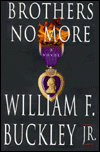
Brothers No More (A Blackford Oakes Novel)

One of the nice things about being (mostly) done with school is that I’ve rediscovered reading for pleasure. I’ve read a lot of genres over the years, sometimes focusing on one or the other- horror, sci-fi, classics, mysteries, novels, whatever really. As a young person one tends to think that one is a (x) kind of reader: I’m a sci-fi fan! (except for all the sci-fi that stinks), or later, I’m a fan of novels! (except for all the ones that stink). It’s the same with music. The younger music afficionado tends to have just one style, perhaps just one artist or composer. But as one ages and grows more sophisticated, one learns that what is interesting is what is good, not what fits a particular definition.

That’s just prelude, really, and has nothing to do with this book, except to say that I liked this book, but only because it was good. It didn’t even particularly matter that it was written by one of my heroes of political commentary (although that’s what piqued my curiosity to buy it). If it weren’t good, I wouldn’t read any more of Buckley’s fiction and instead just read his commentary. Just as, for example, I like Sean Penn’s movies, but don’t much value his political insights (I just resisted a strong urge to put scare quotes around that last word).

Brothers No More is a novel by William F. Buckley about a subject, or perhaps one should say in a genre, that he visits often- that is, the Cold War. This book isn’t about the Cold War at all, though, which is why perhaps ‘genre’ is better than ‘subject’. The Cold War is just the backdrop for a story that is simply about human nature.

It’s the story of two school friends who fight in Italy together during WWII. One of those friends reveals a deep character flaw in that fighting, a flaw that the other friend helps him cover up. But the revelation of this flaw ends up working a surprising result- as the one friend becomes starkly aware of his own weakness, he struggles to overcome his flaw by developing his deficient character, while the other friend, believing himself to be superior to his friend due to the revelation of the flaw, is blinded to his own flaws and thus does not struggle to mitigate them, but rather allows them to bloom into full flower. The friends are followed through the next few decades as their lives take very different paths, but who are always linked by the sister of one who married the other, and by the memories of the days in Italy when so much was revealed about them.

I’ve always known that Buckley was a great writer. He’s known for his prodigious vocabulary and his very expressive commentary. But he’s a very terse, natural fiction writer, which might seem like a conflicting skill set. It’s not a hugely substantial book, and spends little time philosophizing or sermonizing about the subject. He lets the story tell itself. You can tell that he’s a writer with a sense of humor as well, as he allows himself to be the target of the hatred of one of the sympathetic characters:

To round out the political coverage, the Times told her to do a feature on Conservative Party candidate William F. Buckly, Jr. She spent a few days reading his books, his columns, and listening to one of his campaign speeches. She reported to the City Editor that she could not do a feature on him, but would gladly volunteer to serve on it if ever an execution squad were organized.

She’s a complete liberal, and yet Buckley makes her one of the good guys (gals?). And he does it not in some obvious patronizing way to prove that he was just writing fiction, not politicizing, and the reader barely even notices, because Buckley IS just writing fiction and not politicizing.

As a side benefit, one learns a few things about FDR, WWII, Vietnam, and other subjects of this period of history. Like any good work of fiction set in a historical setting, it teaches about its setting in a way subtle enough to not intrude on the story.

But more important, it teaches about the human subject. At the end of the day, this is the only real subject there is in fiction, or at least the only one I’m interested in. I learned long ago that I did not find certain sci-fi books interesting and others very dull because the one had superior laser gun fights or more interesting spaceships, but because the one more truthfully revealed the human character reacting in the environment. It’s the same with any genre- the genre is just the canvas that the author uses to paint or sketch or sculpt or render what’s really interesting- the only thing that’s really interesting- the human being, interacting.

Another interesting thing has happened to me, as I become increasingly involved with people on a professional level- I find myself increasingly drawing on good fiction for insight into how I can expect people to behave. I find this one of the most trustworthy predictors of human behavior. I say to myself, If this were a fairy tale or a folk tale or a good novel, and there were a character acting like that person, what would I expect would happen to that character by the end? Is he the villain or the hero of the piece? It’s usually guided me accurately. Good fiction is the human race’s repository of natural wisdom, and I felt like this book added a few more things to my small repository.

Emerging problems

Rusty comments here on some signs that the Emergent church is about more than an aesthetic change, but a theology change. He’s right, of course. Aesthetic changes never happen in a vacuum, I don’t think. If I came to work in a business suit every day for 20 years, and one day showed up in a hawaiian shirt and cutoffs, you’d suspect I may have had a change in my outlook on life that went a little deeper than my wardrobe. But if you actively denigrate systems of theology, you can at best expect that some will use that to sneak some heresy in the backdoor, and at worst, the choice to denigrate systems is itself heresy. These guys believe very passionately in the importance of the medium used to communicate, so we shouldn’t be surprised that there’s something very substantial underlying their desires to change that medium.

And don’t worry, Rusty. They don’t like me too much anymore either.

The Southern Baptists continue to take a stand

The Southern Baptist Convention has decided to pull out of the Baptist World Alliance, because of the BWA’s “left-leaning stance.” Good for them for taking a stand.

I heard an interview yesterday on NPR, with Rev. Paige Patterson, the president of South Western Baptist Theological Seminary, about the decision. He said the decision was due to the BWA’s positions on gay marriage, inerrancy and female pastors.

Melissa Block’s hostility was almost palpable, even suggesting to Rev. Patterson that the SBC would be better off with a more ‘big tent’ approach. What exactly Ms. Block knows about what would or would not help the SBC be stronger is not entirely clear. It would be like Pat Robertson suggesting ways that Planned Parenthood could improve its mission statement. But Rev. Patterson gave an excellent answer, saying that the big tent approach was precisely the problem, and that Jesus warned against that kind of approach with His wide way / narrow way analogy. He said their responsibility was simply to be true to their convictions, and to be true to Scripture.

We could use more like Rev. Patterson and the SBC. And some might suggest to Ms. Block a more professional approach to her field.